
JQ Magazine: Concert Review – At NJPAC, Herbie Hancock Still Lives in the Future
By JQ magazine editor Justin Tedaldi (CIR Kobe-shi, 2001-02). Justin has written about Japanese arts and entertainment for JETAA since 2005. For more of his articles, click here. Photos by Shakiru Bola Okoya.
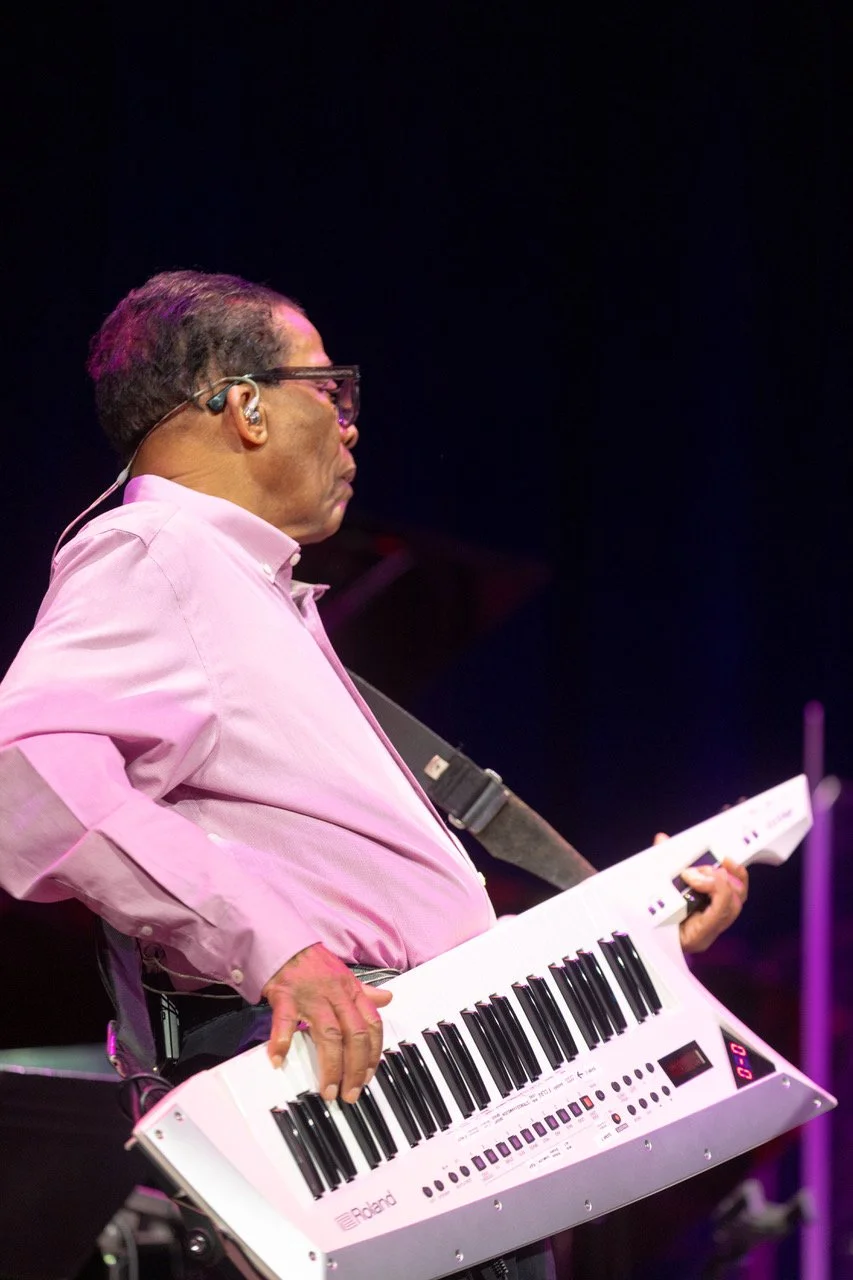
The jazz icon brought six decades of innovation—and boundless youthful energy—to NJPAC before the venue's summer transformation.
"I feel like I'm in my living room with a bunch of my friends."
It was an offhand remark from Herbie Hancock as he greeted a sold-out Prudential Hall at the New Jersey Performing Arts Center on July 31, but it perfectly summarized the next two hours. There was no sense of distance between one of the most celebrated musicians in modern history and the audience that had gathered to see him. Instead, Hancock invited everyone into an evening of shared discovery, humor, experimentation, and joy—an approach that has defined his remarkable career for more than six decades.
At 86 years old, Hancock remains one of the rare artists who refuses to become a curator of his own legacy. Rather than recreating beloved recordings note for note, he continues to reshape them in real time. Every performance is an experiment. Every solo is a conversation. Every composition remains unfinished in the best possible sense.
That philosophy was on full display in Newark as Hancock led an exceptional five-piece ensemble through acoustic jazz, funk, fusion, electronics, Brazilian influences, spoken humor, and even vocoder experimentation. Rather than a retrospective, it was proof that one of jazz's greatest innovators is still searching for new sounds.
The evening also marked one of the final major performances at NJPAC before Prudential Hall temporarily closes later this summer as part of the arts center's continuing campus improvements. The renovations, part of NJPAC's long-term redevelopment and modernization project, will upgrade audience spaces while preparing the venue for decades of future performances. It was difficult to imagine a more fitting artist to close this chapter. Like Hancock himself, NJPAC continues to reinvent itself while respecting its remarkable history.
Few musicians have altered the course of modern music as dramatically as Herbie Hancock. After first attracting national attention as pianist for trumpeter Donald Byrd, Hancock quickly established himself at Blue Note Records before joining Miles Davis' legendary Second Great Quintet alongside Wayne Shorter, Ron Carter, and Tony Williams. Together they transformed jazz harmony, rhythm, and improvisation during one of the genre's most revolutionary periods. His own recordings became equally influential, with funk and electronic innovations sparking collaborations with artists across every imaginable genre. His achievements include an Academy Award for Round Midnight, fourteen Grammy Awards, Kennedy Center Honors, designation as a National Endowment for the Arts Jazz Master, and countless other accolades. Remarkably, none of it seems to matter to Hancock nearly as much as his next musical idea.
While Hancock is revered worldwide, few countries have embraced him as warmly as Japan, beginning with his first tours there during the 1960s. Part of that admiration stems from Japanese musical culture itself. The country's audiences have long celebrated technical mastery while simultaneously encouraging artistic evolution. Hancock embodies both ideals. Whether performing standards, funk, experimental electronics, or modern jazz, he approaches every performance with the curiosity of a student rather than the certainty of a legend. Even today, Hancock continues to tour Japan regularly, where audiences span multiple generations. That spirit of lifelong discovery could be heard throughout the Newark performance.
The evening opened with "Maiden Voyage." More than sixty years after recording the composition, Hancock continues finding new pathways through it. Rather than simply presenting the familiar melody, the band allowed the music to emerge slowly from shimmering harmonies before settling into an expansive groove.
Every member of the quintet contributed subtle textures, and helped establish the central theme of the evening: Nothing was being recreated. Everything was being rediscovered.
The first major surprise arrived when Hancock presented two dramatically different arrangements of "Watermelon Man." Originally recorded in 1962 as a soulful hard-bop composition before being completely reinvented as one of the signature tracks of Head Hunters, "Watermelon Man" essentially chronicles Hancock's own artistic evolution. Hearing both versions in a single performance illustrated how one composition can contain multiple identities. The first leaned into blues traditions and swinging sophistication. The second exploded into deep funk, infectious grooves, and rhythmic interplay that had audience members instinctively moving in their seats.
Introducing another Headhunters-era selection, Hancock explained with a smile: "The Headhunters liked to do this tune because everyone got a chance to solo."
That wasn't merely historical commentary; it described the entire evening.
Although Hancock remains the unquestioned leader, this ensemble functions as genuine musical democracy. Every player receives space to shape the direction of each composition.Trumpeter Terence Blanchard repeatedly brought the audience to spontaneous applause before his solos had even concluded. His tone was immense—warm, rounded, and astonishingly full. At times his trumpet genuinely sounded like an entire horn section, filling Prudential Hall with rich harmonic overtones that seemed impossible from a single instrument.
Blanchard's résumé rivals almost anyone in contemporary jazz. A five-time Grammy winner, Oscar-nominated film composer for Spike Lee, acclaimed opera composer, and former artistic director of the Herbie Hancock Institute of Jazz, he remains one of the most versatile musicians working today. His arrangement of Wayne Shorter's "Footprints" later in the evening would become one of the concert's emotional highlights.
If Blanchard delivered the evening's biggest trumpet moments, bassist James Genus may have stolen the show. Now in his seventeenth year performing with Hancock—and familiar to millions as bassist for the Saturday Night Live band—Genus demonstrated astonishing melodic creativity. One extended solo immediately recalled the lyrical virtuosity of Jaco Pastorius. Introducing him, Hancock shared one of the night's funniest moments. Quoting Blanchard, he laughed: "If he plays a solo, that's a whole band right there."
Then Hancock looked back toward Genus. "I think there's more than one of you." After another dazzling passage he continued. "I don't know how one guy can get so much..." He paused. "I think he's AI." Another pause. "Actually... I think he's a robot."
The hall erupted in laughter.
Beninese guitarist Lionel Loueke remains one of jazz's most imaginative voices. Blending African musical traditions, jazz harmony, Brazilian rhythms, and remarkable vocal effects, Loueke consistently erased the distinction between guitar and human voice. His interplay with Hancock became one of the evening's defining pleasures.
Drummer Jaylen Petinaud anchored everything with maturity far beyond his years Whether navigating whisper-soft passages or explosive fusion grooves, he maintained perfect balance between precision and spontaneity.
Midway through the evening came one of Hancock's greatest fusion compositions: "Actual Proof." Performed in its full electric incarnation, the tune became an exhilarating explosion of rhythmic complexity. Hancock spent much of the performance behind his Korg Kronos synthesizer, layering textures while effortlessly switching between futuristic electronic colors and acoustic piano architecture. The groove remained impossibly tight. The improvisation remained completely free. The result was controlled chaos in the best possible sense.
Despite the staggering musicianship, Hancock never allowed the evening to become overly serious. Early in the performance he acknowledged that one of his hands remained in a protective sling. "I've got my hand in a sling," he joked. "Let's see if I've still got five fingers." Judging from the dazzling keyboard work that followed, there was little cause for concern.
Later, demonstrating his synthesizer's harmonic capabilities, Hancock grinned. "I can sing chords..." A moment later he interrupted himself. "My nose is running." Without missing a beat: "That's why we have Kleenex." It was vintage Hancock—equal parts musical genius and endlessly approachable storyteller.
Perhaps the evening's most revealing moment came when Hancock introduced a newer composition tentatively titled “Lionel/Felix 2019.” "You don't mind hearing something that's not finished?" For Hancock, compositions remain living organisms. He began singing the opening vocal melody before Lionel Loueke seamlessly continued the line through both voice and guitar. The music floated somewhere between Brazilian bossa nova, contemporary jazz, and folk song, with echoes that occasionally recalled the gentle emotional pull of Sting’s "Shape of My Heart."
Another newer composition, "Secret Sauce," demonstrated Hancock's continuing fascination with electronic sound design. Introducing it as "something a little quieter," the piece opened with overlapping vocoder voices that created an almost chant-like atmosphere. Gradually the electronic textures dissolved. James Genus introduced a thick, swampy bass groove.
Hancock responded by building intricate acoustic piano structures over the top, creating a fascinating conversation between digital atmosphere and earthy funk. Few musicians remain this adventurous after sixty years, and fewer still make experimentation feel this inviting.
One of the evening's lyrical highlights came with "Butterfly." Long cherished by Japanese audiences, the composition has become one of Hancock's most beloved international works. Its graceful melody unfolded patiently while the band emphasized warmth over virtuosity. The performance served as another reminder of Hancock's remarkable connection with Japan—a country where "Butterfly" remains especially admired and where audiences have embraced his continual artistic evolution for generations.
The emotional center of the evening arrived with "Footprints." Introducing the composition, Hancock affectionately referred to "Newark's own Wayne Shorter," paying tribute to his late friend, collaborator, and fellow Miles Davis bandmate. Rather than recreating the saxophonist’s familiar recording, the ensemble performed Terence Blanchard's arrangement. The interpretation emphasized warm trumpet sonorities, elegant walking bass, and graceful harmonic movement. Blanchard's trumpet sounded almost orchestral—rich enough to suggest an entire horn section emerging from a single bell. It was less a memorial than a celebration of musical friendship spanning more than half a century.
The final stretch became an exhilarating sprint through Hancock's fusion classics. A compact medley connected "Hang Up Your Hang Ups," "Spider," and "Rockit," giving audiences brief but thrilling reminders of Hancock's electronic innovations before moving seamlessly into the unmistakable opening groove of "Chameleon." If Hancock had deliberately stayed stage right for much of the concert—allowing the front line to command attention—he finally stepped into center stage for the finale.
Trading phrases with Lionel Loueke and James Genus, Hancock played with the exuberance of someone discovering the piece for the first time rather than someone who had performed it thousands of times. Blanchard even moved to additional keyboards, thickening the already enormous groove as the band built toward its climactic ending. Then came perhaps the night's most delightful image.
Herbie Hancock—86 years old—was literally pogoing behind the keyboards. The audience erupted. As the final notes faded, Hancock simply smiled. "Thank you so much! Did you have fun?" Judging from the standing ovation that followed, the answer was obvious. He waved enthusiastically toward every section of Prudential Hall before jogging offstage with astonishing energy, disappearing as quickly as he had appeared.
For a performer entering his seventh decade as an international touring artist, it was almost unbelievable. Then again, Herbie Hancock has spent his entire career doing exactly that. The evening wasn't merely a concert, it was a reminder that true artistry isn't measured by age or awards (of which he has plenty), but by curiosity. Hancock has never stopped asking musical questions, never stopped listening, and never stopped imagining what comes next.
As NJPAC prepares to renovate its home for a new generation of audiences, Herbie Hancock demonstrated what genuine renewal looks like. At 86, he isn't preserving jazz history.
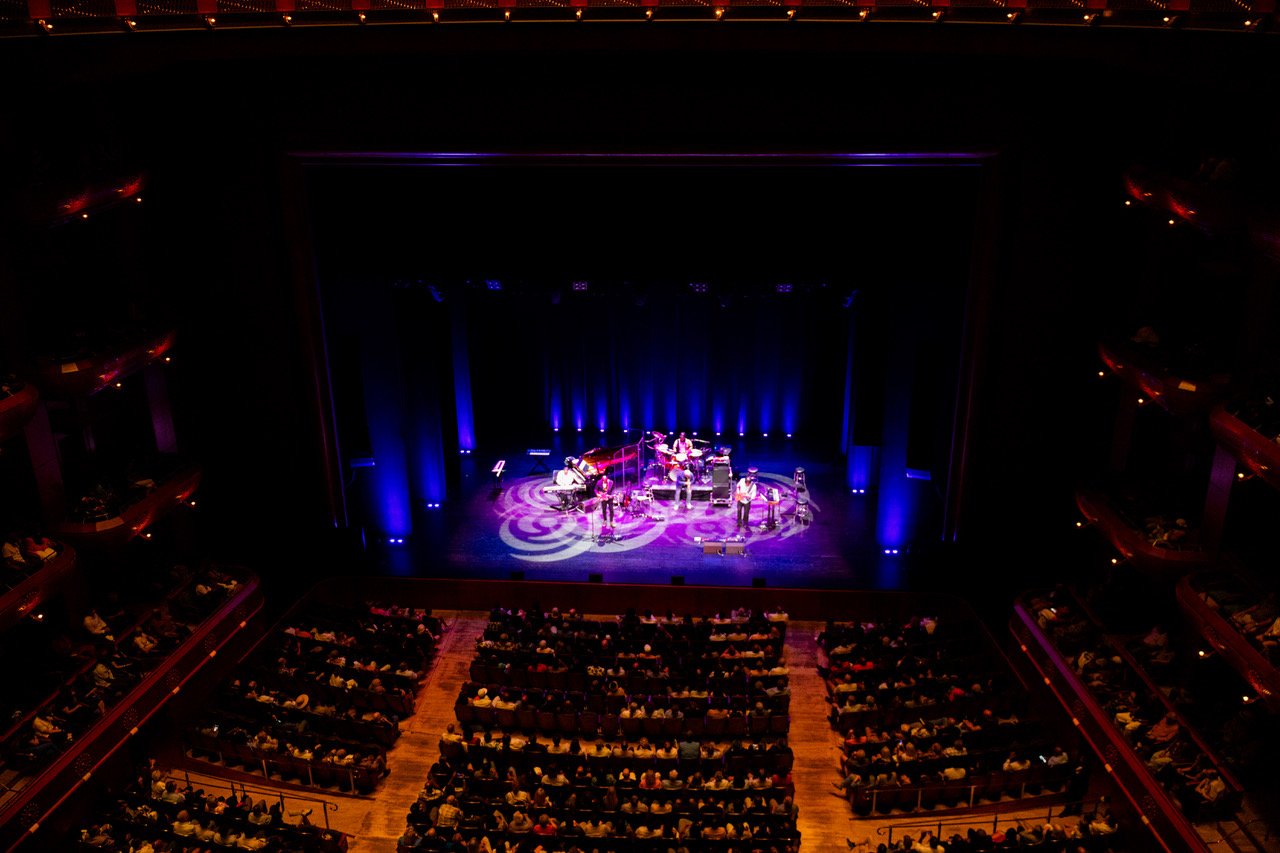
He's still writing it.
For more JQ articles, click here.